

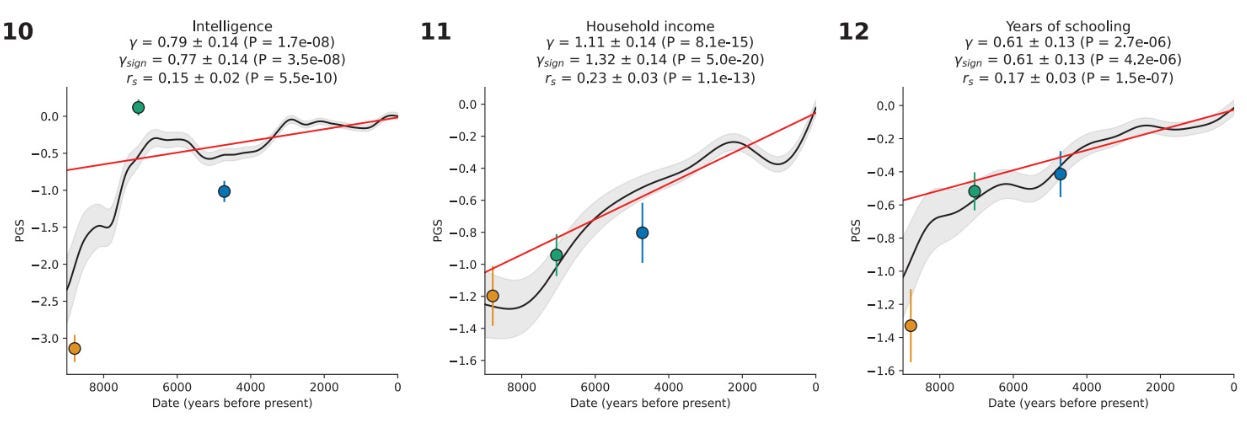
Cognitive evolution among Europeans, as shown by analysis of ancient DNA with three measures of cognitive ability (i.e., alleles associated with intelligence, household income, or years of schooling). Source
The latest Reich Lab paper shows that evolution didn’t stand still for Europeans. Especially noteworthy is the sharp rise in cognitive ability between 9,000 and 7,000 years ago, followed by a more gradual one until the time of Christ.1
The rise, in itself, is expected. Around 10,000 years ago, farming began to spread out of the Middle East and into Europe, where it replaced hunting and gathering and set off a cascade of changes: population growth, formation of villages and towns, increase in trade, specialization of labor, development of religion, rise of the state, numeracy and literacy, and much more. These changes imposed new demands on both mind and body, but especially on the mind. There was thus selection for higher cognitive ability.
But the initial rise was unusually sharp. We see nothing like it in the cognitive evolution of East Asia after the advent of farming. There is just a gradual increase until 1,500 years ago.2
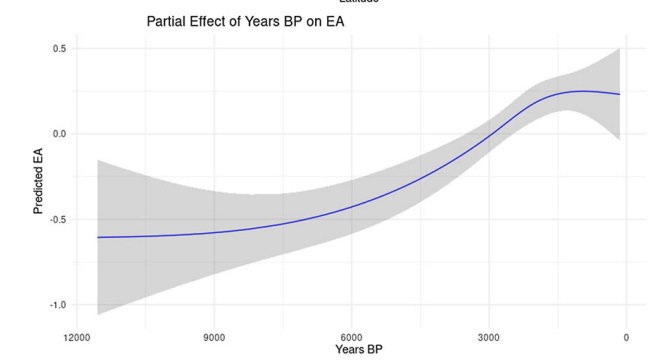
Cognitive evolution of East Asians, as shown by one measure of cognitive ability (i.e., alleles associated with educational attainment). Source
Does Europe show an initial surge simply because early farmers were adapting to the demands of farming? Or were they intermixing with a population of higher cognitive ability as they moved farther north into Europe?
The second explanation resonates with an opinion widely held in the nineteenth century:3
All this is due to the fact that necessity is the mother of invention, because those tribes that emigrated early to the north, and there gradually became white, had to develop all their intellectual powers, and invent and perfect all the arts in their struggle with need, want and misery, which in their many forms, were brought about by the climate. This they had to do in order to make up for the parsimony of nature, and out of it came their high civilization. Arthur Schopenhauer, 1851
So when a glacial epoch comes on, some animals must acquire warmer fur, or a covering of fat, or else die of cold. Those best clothed by nature are, therefore, preserved by natural selection. Man, under the same circumstances, will make himself warmer clothing, and build better houses; and the necessity of doing this will react upon his mental organisation and social condition […].
A hardier, a more provident, and a more social race would be developed, than in those regions where the earth produces a perennial supply of vegetable food, and where neither foresight nor ingenuity are required to prepare for the rigours of winter. And is it not the fact that in all ages, and in every quarter of the globe, the inhabitants of temperate [countries] have been superior to those of tropical countries? All the great invasions and displacements of races have been from North to South, rather than the reverse.
Alfred Russell Wallace, 1864
And the transition from the uniformly hot climate of the original home of man to colder regions, where the year was divided into summer and winter, created new requirements – shelter and clothing as protection against cold and damp, and hence new spheres of labour, new forms of activity, which further and further separated man from the animal.
Friedrich Engels, 1876
This is “cold winters theory.” It lost ground during the late twentieth century, as did any view of human differences as more than skin-deep. There nonetheless were proponents, like Richard Lynn. After the turn of the millennium, it lost further ground as evidence mounted for recent cognitive evolution at temperate or even subtropical latitudes, among such groups as Ashkenazi Jews,4 the Chinese,5 and the English from the late Middle Ages onward.6
The latter view has particularly gained ground through studies of ancient DNA, beginning with one led by Michael Woodley of Menie in 2017. There then followed two others led by Yunus Kuijpers and Davide Piffer, as well as regional studies by Davide Piffer, Emil Kirkegaard, Gregory Connor, and others. Finally, in 2026, this research went mainstream with a paper by Ali Akbari and others at the Reich Lab.7 All of these studies show a long-term rise in mean cognitive ability after the advent of farming and the cultural changes it caused directly or indirectly.
But the rise was not uniform. Western Europeans made a great leap forward from the fourteenth to the nineteenth century, with the rapid demographic expansion of their middle class.8 There have also been at least three cases of stagnation or decline: Imperial Rome;9 post-Sui China;10 and the post-1900 West11 — apparently due to a fertility decline within higher social classes.
A return of cold winters theory?
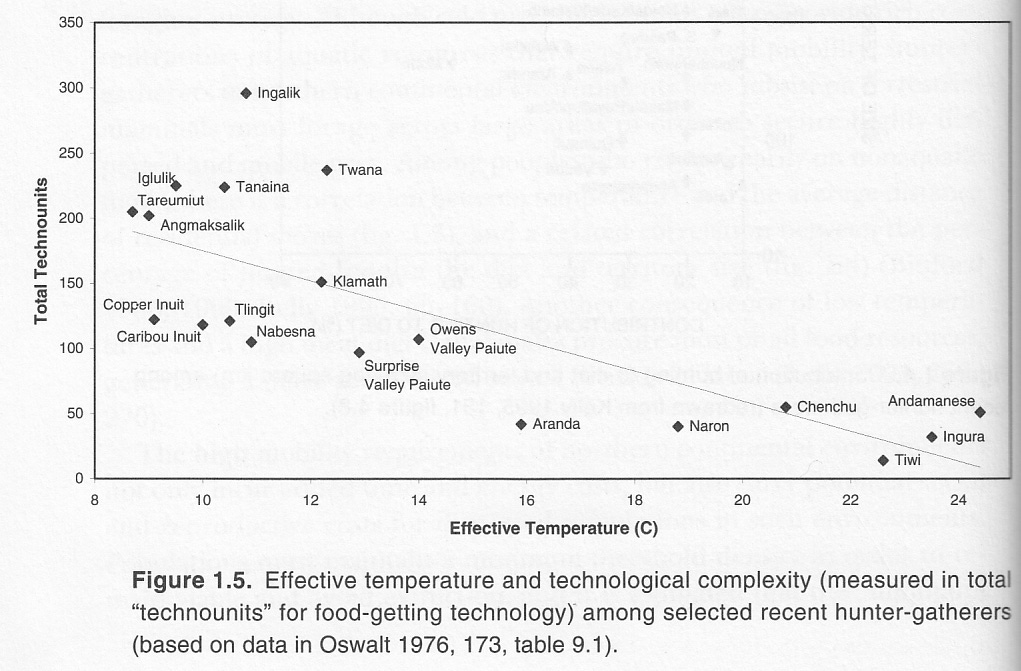
Cold winters theory may still be true for the stage of hunting and gathering. During this period (> 10,000 years ago), mean IQ seems to have been higher at higher latitudes. This north-south gradient shows up in an inverse correlation between temperature and technological complexity among recent hunter-gatherers:12
The same north-south gradient also shows up in geographic variation at COMT, a gene linked to executive function, working memory, and intelligence. A decade and a half ago, Davide Piffer found a positive correlation (0.57) between mean population IQ and the frequency of the derived COMT allele (Met). This allele is also more frequent in farming societies than in hunter-gatherers, with one interesting exception: “hunter-gatherers living at high latitudes (Inuit) show high frequencies of the Met allele, possibly due to the higher pressure on technological skills and planning abilities posed by the adverse climatic conditions near the North Pole.”13
Piffer has now revisited this question with new data. The derived allele seems to have originated within certain hunter-gather groups and then spread to early European farmers:14
Ancient hunter-gatherer-rich groups are not low in Met(A). Several are very high. Iron Gates hunter-gatherers, Baltic hunter-gatherers, core WHG groups, and EHG or steppe-forager-like groups all sit above early Anatolian and European farmer groups. Yamnaya is elevated, but not uniquely so. The signal is older and broader than Yamnaya.
That reverses the simple modern farmer-vs-hunter-gatherer contrast from the earlier paper. With ancient DNA, Met(A) does not look like a farming allele. It looks like an allele that was already common in parts of the northern and western Eurasian forager world, then carried forward through later mixtures.
Keep in mind that the earliest farmers differed from the later ones. In Anatolia and northern Greece, farmers initially had African nasal and facial traits. They also had dark skin and brown eyes, according to DNA from the remains of three farmers who lived in northern Greece 7,500 to 5,500 years ago.15 They were probably like the Natufians of the Levant, who lived 15,000 to 11,500 years ago and were anatomically equidistant between present-day West Africans and present-day Middle Easterners.
This was the conclusion of a study of craniofacial data from European skeletal remains. The same study also concluded that Europe’s earliest farmers largely died out:16
… it is no surprise that all modern European groups, ranging all of the way from Scandinavia to eastern Europe and throughout the Mediterranean to the Middle East, show that they are closely related to each other. The surprise is that the Neolithic peoples of Europe and their Bronze Age successors are not closely related to the modern inhabitants, although the prehistoric/modern ties are somewhat more apparent in southern Europe. It is a further surprise that the Epipalaeolithic Natufian of Israel from whom the Neolithic realm was assumed to arise has a clear link to Sub-Saharan Africa.
Discussion
Northern hunter-gatherers were as different from other hunter-gatherers as both were from farmers. Particularly different was their sexual division of labor, and the cognitive demands it created.
Women had few opportunities for food gathering most of the year, so they specialized in tasks like weaving, pottery, needlework, garment making, leatherworking, shelter building, and ornamentation. For these tasks, they invented new tools, like hand-powered rotary drills to make ornamental objects and perhaps fire. They also built kilns heated to between 500 and 800 degrees C. and made a wide range of woven goods: ropes for rafts and nets, knotted netting, plaited wicker-style basketry, and textiles.
Men hunted over a larger area, due to the lower carrying capacity of the land. Their minds thus had to store and manipulate huge amounts of spatiotemporal data to predict how game animals move across time and space. There was also the seasonal climate, which made food and fuel available only for limited periods. This problem was solved by (1) budgeting time over the yearly cycle, (2) developing specific tools for specific tasks, (3) using untended devices (e.g., pits, traps, weirs, and nets), and (4) digging storage pits down to the permafrost to refrigerate meat for year-round consumption and bones for winter fuel.
In sum, both sexes took on higher-order tasks that needed more judgement, abstraction, and creativity. The northern tier of Eurasia thus created humans who were “pre-adapted” to the cognitive demands that came with farming. Over time, they would spread south, replacing earlier populations that could less easily exploit the possibilities of the new cultural environment.17
Such replacement may have happened through invasion, as Wallace thought. Or by other means. There is evidence of a plague that swept through Neolithic farming communities in three waves 5,300 to 4,900 years ago, and which coincided with a marked reduction in the number of human remains and a cessation of megalith building.18 On a less dramatic scale, Neolithic communities were perhaps regularly thinned out by epidemics and then replenished by a constant stream of hunter-gatherers. In either case, the process of demographic replacement may have been gradual and nonviolent, taking such forms as purchase of slaves or brides, use of migrant farm labor, hiring of mercenaries, and so forth.
The cognitive surge from 9,000 to 7,000 years ago may thus reflect farming communities assimilating outsiders of higher cognitive ability. Researchers initially thought the latter were steppe pastoralists like the Yamnaya, but the COMT data point to an older source, possibly the hunter-fisher-sealers who formed large semi-sedentary communities around the North Sea and the Baltic.19 This late Mesolithic population is today genetically closest to the Baltic peoples and the Finns.20
The last point might explain why Finns rank so high on IQ tests, PISA rankings, and polygenic scores — only Ashkenazi Jews have a higher polygenic score among Europeans.21 Yet, unlike Ashkenazim, Finns do not have a history of specializing in trade, which has generally driven cognitive evolution in recent times. A trading middle class arose relatively late in Finland, essentially from the sixteenth century onward, and even then was largely of Swedish origin.
Footnotes
Akbari, A., Perry, A., Barton, A.R. et al. (2026). Ancient DNA reveals pervasive directional selection across West Eurasia. Nature April 15. https://doi.org/10.1038/s41586-026-10358-1
Piffer, D. (2025). Directional Selection and Evolution of Polygenic Traits in Eastern Eurasia: Insights from Ancient DNA. Twin Research and Human Genetics, 28(1), 1-20. https://doi.org/10.1017/thg.2024.49
In East Asia, as in the Imperial Era of Rome, civilization reached a point where much of the elite lost interest in having children. See:
Frost, P. (2025). Cognitive evolution in eastern Eurasia, Aporia Magazine, March 25.
Schopenhauer, S. (1851). Parerga and Paralipomena: Short Philosophical Essays, 1st ed.; Payne, E.F.J., Translator; Clarendon Press: Oxford, UK, 2000; Volume 2.
Wallace, A.R. (1864). The Origin of Human Races and the Antiquity of Man deduced from the Theory of “Natural Selection. J. Anthropol. Soc. Lond. 2, clviii–clxxxvii. https://digitalcommons.wku.edu/cgi/viewcontent.cgi?referer=&httpsredir=1&article=1005&context=dlps_fac_arw
Engels, F. (1876). The Part Played by Labor in the Transition from Ape to Man. Transl. from the German by C. Dutt. Moscow: Progress Publishers. https://www.marxists.org/archive/marx/works/1876/part-played-labour/index.htm
Cochran, G., Hardy, J., & Harpending, H. (2006). Natural history of Ashkenazi intelligence. Journal of Biosocial Science, 38(5), 659-693. https://doi.org/10.1017/S0021932005027069
Diamond, J.M. (1994). Jewish Lysosomes. Nature, 368, 291-292. https://doi.org/10.1038/368291a0
Dunkel, C.S, Woodley of Menie, M.A., Pallesen, J., & Kirkegaard, E.O.W. (2019). Polygenic scores mediate the Jewish phenotypic advantage in educational attainment and cognitive ability compared with Catholics and Lutherans. Evolutionary Behavioral Sciences, 13(4), 366-375. https://psycnet.apa.org/doi/10.1037/ebs0000158
Kirkegaard, E. (2026). Genetic evidence of Ashkenazi intelligence, Just Emil Kirkegaard Things, April 28. https://www.emilkirkegaard.com/p/genetic-evidence-of-ashkenazi-intelligence
Piffer, D. (2019). Evidence for Recent Polygenic Selection on Educational Attainment and Intelligence Inferred from Gwas Hits: A Replication of Previous Findings Using Recent Data. Psych, 1, 55-75. https://doi.org/10.3390/psych1010005
Unz, R. (2013). How Social Darwinism Made Modern China. The American Conservative, March 11. https://www.theamericanconservative.com/how-social-darwinism-made-modern-china-248/
Clark, G. (2007). A Farewell to Alms. A Brief Economic History of the World. Princeton University Press: Princeton. https://press.princeton.edu/books/paperback/9780691141282/a-farewell-to-alms
Clark, G. (2009). The domestication of man: the social implications of Darwin. ArtefaCToS, 2, 64-80. https://www.researchgate.net/publication/277275046_The_Domestication_of_Man_The_Social_Implications_of_Darwin
Clark, G. (2023). The inheritance of social status: England, 1600 to 2022. Proceedings of the National Academy of Sciences, U.S.A., 120(27), e2300926120 https://doi.org/10.1073/pnas.2300926120
Akbari, A., Perry, A., Barton, A.R. et al. (2026). Ancient DNA reveals pervasive directional selection across West Eurasia. Nature April 15. https://doi.org/10.1038/s41586-026-10358-1
Kuijpers, Y., Domínguez-Andrés, J., Bakker, O.B., Gupta, M.K., Grasshoff, M., Xu, C.J., Joosten, L.A.B., Bertranpetit, J., Netea, M.G., & Li, Y. (2022). Evolutionary Trajectories of Complex Traits in European Populations of Modern Humans. Frontiers in Genetics, 13, 833190. https://doi.org/10.3389/fgene.2022.833190
Piffer, D. (2025). Directional Selection and Evolution of Polygenic Traits in Eastern Eurasia: Insights from Ancient DNA. Twin Research and Human Genetics, 28(1), 1-20. https://doi.org/10.1017/thg.2024.49
Piffer, D., & Connor, G. (2025b). Genomic Evidence for Clark’s Theory of the Industrial Revolution, preprint, ResearchGate, November.
Piffer D, Dutton, E., & Kirkegaard, E.O.W. (2023). Intelligence Trends in Ancient Rome: The Rise and Fall of Roman Polygenic Scores. OpenPsych, July 21, 2023. https://doi.org/10.26775/OP.2023.07.21
Piffer, D., & Kirkegaard, E. O. (2024). Evolutionary trends of polygenic scores in European populations from the Paleolithic to modern times. Twin Research and Human Genetics, 27(1), 30-49. https://doi.org/10.1017/thg.2024.8
Woodley, M. A., Younuskunju, S., Balan, B., & Piffer, D. (2017). Holocene selection for variants associated with general cognitive ability: Comparing ancient and modern genomes. Twin Research and Human Genetics, 20(4), 271-280. https://doi.org/10.1017/thg.2017.37
Piffer, D., & Connor, G. (2025b). Genomic Evidence for Clark’s Theory of the Industrial Revolution, preprint, ResearchGate, November. https://www.researchgate.net/publication/392808200_Genomic_evidence_for_Clark’s_theory_of_the_Industrial_Revolution
Frost, P. (2026). Cognitive evolution in Western Europe. Peter Frost’s Newsletter. February 16.
Piffer D, Dutton, E., & Kirkegaard, E.O.W. (2023). Intelligence Trends in Ancient Rome: The Rise and Fall of Roman Polygenic Scores. OpenPsych, July 21, 2023. https://doi.org/10.26775/OP.2023.07.21
Frost, P. (2023). Was the Roman Empire eugenic? Peter Frost’s Newsletter, December 11.
Frost, P. (2024). How Christianity rebooted cognitive evolution. Peter Frost’s Newsletter, November 13.
Piffer, D. (2025). Directional Selection and Evolution of Polygenic Traits in Eastern Eurasia: Insights from Ancient DNA. Twin Research and Human Genetics, 28(1), 1-20. https://doi.org/10.1017/thg.2024.49
Frost, P. (2025). Cognitive evolution in eastern Eurasia. Peter Frost’s Newsletter, March 25.
Beauchamp, J.P. (2016). Genetic evidence for natural selection in humans in the contemporary United States. Proceedings of the National Academy of Sciences, 113(28), 7774-7779. https://doi.org/10.1073/pnas.1600398113
Hugh-Jones, D., and A. Abdellaoui. (2022). Human Capital Mediates Natural Selection in Contemporary Humans. Behavior Genetics, 52, 205-234. https://doi.org/10.1007/s10519-022-10107-w
Kong, A., M.L. Frigge, G. Thorleifsson, H. Stefansson, A.I. Young, F. Zink, G.A. Jonsdottir, A. Okbay, P. Sulem, G. Masson, D.F. Gudbjartsson, A. Helgason, G. Bjornsdottir, U. Thorsteinsdottir, and K. Stefansson. (2017). Selection against variants in the genome associated with educational attainment. Proceedings of the National Academy of Sciences, 114(5), E727-E732. https://doi.org/10.1073/pnas.1612113114
Frost, P. (2022). The Great Decline. Peter Frost’s Newsletter, December 20.
Hoffecker, J.F. (2002). Desolate Landscapes. Ice-Age Settlement in Eastern Europe. New Brunswick: Rutgers University Press p. 10.
Piffer, D. (2013). Correlation of the COMT Val158Met polymorphism with latitude and a hunter-gather lifestyle suggests culture-gene coevolution and selective pressure on cognition genes due to climate. Anthropological Science, 121(3), 161–171. https://doi.org/10.1537/ase.130731
Piffer, D. (2026). The Arctic Cognition Gene, 13 Years Later. PifferPilfer, June 3.
Angel, J.L. (1972). Biological relations of Egyptian and eastern Mediterranean populations during Pre-dynastic and Dynastic times. Journal of Human Evolution, 1(3), 307-313. https://doi.org/10.1016/0047-2484(72)90066-8
Anon. (2015). The Archeological Museum of Thessaloniki. Report on ancient DNA -Learn what eye color your ancestor had and what he ate in the Neolithic! Iefimerida. http://www.iefimerida.gr/news/219751/ekthesi-gia-arhaio-dna-mathe-ti-hroma-matia-eihe-kai-ti-etroge-o-neolithikos-progonos
Brace, C.L., Seguchi, N., Quintyn, C.B., Fox, S.C., Nelson, A.R., Manolis, S.K., & Qifeng, P. (2006). The questionable contribution of the Neolithic and the Bronze Age to European craniofacial form. Proceedings of the National Academy of Sciences U.S.A., 103(1), 242-247 https://doi.org/10.1073/pnas.0509801102
Brace, C.L., Seguchi, N., Quintyn, C.B., Fox, S.C., Nelson, A.R., Manolis, S.K., & Qifeng, P. (2006). The questionable contribution of the Neolithic and the Bronze Age to European craniofacial form. Proceedings of the National Academy of Sciences U.S.A., 103(1), 242-247 https://doi.org/10.1073/pnas.0509801102
Frost, P. (2019). The Original Industrial Revolution. Did Cold Winters Select for Cognitive Ability? Psych, 1(1), 166-181. https://doi.org/10.3390/psych1010012
Hoffecker, J.F. (2002). Desolate Landscapes. Ice-Age Settlement in Eastern Europe. New Brunswick: Rutgers University Press.
Zvelebil, M. (2009). Hunters in Transition: Mesolithic Societies of Temperate Eurasia and Their Transition to Farming, 1st ed.; Cambridge University Press: Cambridge, UK.
Seersholm, F. V., Sjögren, K. G., Koelman, J., Blank, M., Svensson, E. M., Staring, J., ... & Sikora, M. (2024). Repeated plague infections across six generations of Neolithic Farmers. Nature, 632(8023), 114-121. https://doi.org/10.1038/s41586-024-07651-2
Price, T. D. (1991). The mesolithic of northern Europe. Annual Review of Anthropology, 211-233. https://doi.org/10.1146/annurev.an.20.100191.001235
Lahr, M. M., Foley, R. A., & Pinhasi, R. (2000). Expected regional patterns of Mesolithic-Neolithic human population admixture in Europe based on archaeological evidence. Archaeogenetics: DNA and the population prehistory of Europe, 81-88. https://d1wqtxts1xzle7.cloudfront.net/7896969/Mirazon-Lahr__Pinhsi__Foley_2000-libre.pdf
Mittnik, A., Wang, C. C., Pfrengle, S., Daubaras, M., Zariņa, G., Hallgren, F., ... & Krause, J. (2018). The genetic prehistory of the Baltic Sea region. Nature Communications, 9(1), 442. https://doi.org/10.1038/s41467-018-02825-9
Piffer, D. (2019). Evidence for Recent Polygenic Selection on Educational Attainment and Intelligence Inferred from Gwas Hits: A Replication of Previous Findings Using Recent Data. Psych, 1(1), 55-75. https://doi.org/10.3390/psych1010005
Dutton, E., & Kirkegaard, E.O. (2014). Fluid g in Scandinavia and Finland: Comparing results from PISA Creative Problem Solving and the WAIS IV matrices subtest. Open Differential Psychology, November 18. https://doi.org/10.26775/2014.11.18
This article is an awesome summary of all the core work you've been covering since you started your sub-stack. Sometimes I've got a bit lost in all of the information that is so wonderfully presented by you but this is just a really well organized summary of the latest stuff and it's brilliant thank you!
This is excellent work. Thank you!
David Reich in an interview with Ali Akbari talked about the acceleration of evolution during the Neolithic-Bronze Age transition. I interpreted this (my framing, not his) as farming having created the conditions for later evolutionary acceleration, but not necessarily the acceleration itself immediately. There were also severe genetic bottlenecks around this time in Europe—presumably tied to the Yanmaya expansion-massive demographic turnover-possible plague decimating Neolithic populations. This would have accelerated genetic drift.
But I am curious about the cognitive changes that might have happened at this time. Perhaps the higher population densities that came with the larger Bronze Age settlements (already becoming civilizations) represented a more decisive shift in terms of environment. I am curious whether the shift from localized mythologies to universal philosophies around this time (the Axial Age) is associated with some kind of cognitive shift in response to this new environment.