

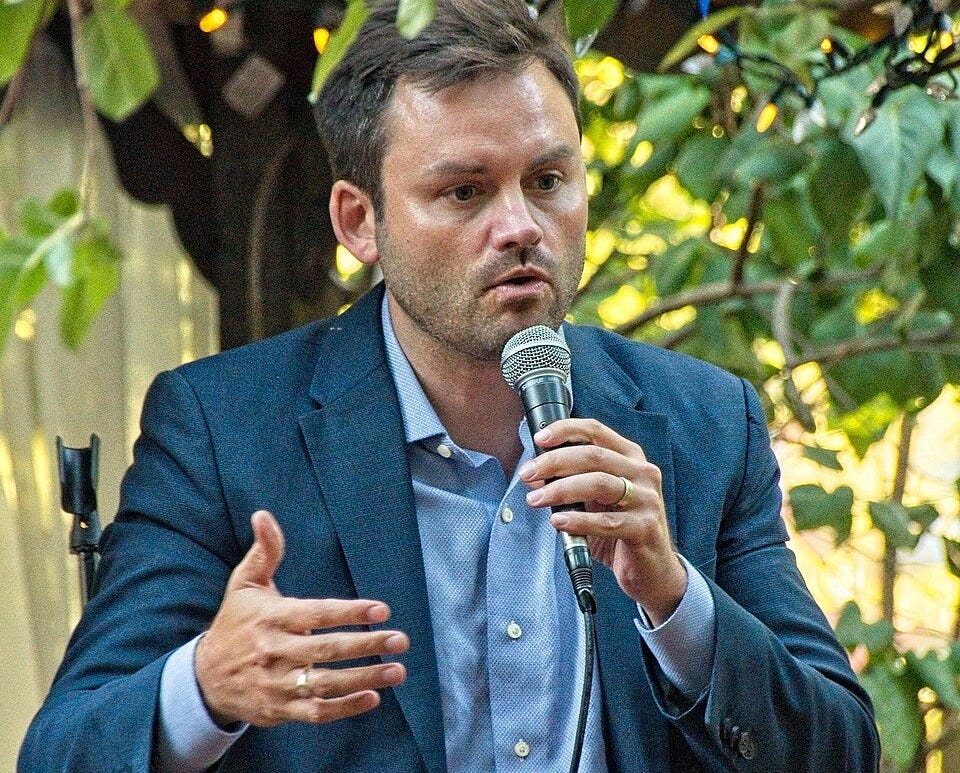
Paul St-Pierre Plamondon, leader of the Parti Québécois (Wikicommons: Alexis G.)
Keith Woods has written a fascinating analysis on Northern Ireland and the evolution of Sinn Féin:
But this leftward shift did not begin with the peace process. It had roots in the political atmosphere out of which the Adams generation emerged. In the late 1960s and early 1970s, the language of civil rights was transforming political conflicts across the West, and in Belfast it offered younger republicans a way to present their grievance on the international stage not only as an Irish national question, but as a broader struggle against discrimination, sectarian policing and minority exclusion. (source)
The following is my take on his analysis.
*******
If we replaced “Belfast” and “Irish” with “Quebec” and “Québécois,” we would have a description of the Quebec national question — up to the year 2020.
In 1968, right and left nationalists came together in a coalition to found the Parti Québécois as the main movement for Quebec independence. The left, however, soon dominated because its framing of the movement’s aims was more in line with the zeitgeist.
The coalition began to fall apart during the late 1990s for two reasons:
The left abandoned its old working-class concerns and embraced those of the new American left. This change alienated not only nationalists on the right but also nationalists on the old left, who disliked the growing emphasis on LGBTQ and the vilification of French Canadians as “settler colonialists” — despite their four centuries of existence in North America and their historical ties with the Amerindian peoples as allies.
Even in power, the Parti Québécois was unable or unwilling to deal with the worsening demographic crisis. On the one hand, fertility had fallen to levels well below replacement. On the other, immigration was rising to unprecedented levels.
There ensued a struggle for control of the party from 2000 onward. In 2020, with the election of Paul St-Pierre Plamondon as leader, the rank and file “vomited” the new left.
Plamondon has recently written an op-ed for a French magazine to express his thoughts on immigration and multiculturalism:1
Canada has long been placing its bets on multiculturalism, which pushes immigrant populations to live parallel to the host society and enclosed in their communities of origin. This is the misnamed model of reasonable accommodation and [the resulting] exacerbation of religious rights. Throughout the world, we are seeing the failure of this model and its obvious consequences for social cohesion. Yet Canada, for its part, has chosen to double down.
… Quebec has been experiencing a strong migration pressure imposed by Canada, which is using its control of the borders and airports to impose its ideological agenda. Our population has only 9 million people. From 2022 to 2024, we received 430,000 new immigrants. On the scale of France, this is equal to adding 3.3 million people in only three years. The consequences of Canada’s immigration policies are documented: a crisis in housing and public services, a sharp decline of the French language, and an undermining of the model of integration that was once perceived as a successful model by Québécois.
The Parti Québécois will likely win the next election in October and then hold a referendum on independence. If the “Yes” vote prevails, Canada will collapse like a house of cards. There is little holding the country together, other than the inertia of having been a country for the past century and a half.
How the collapse may play out
Since the 2008 global economic crisis, Canada, like most Western countries, has been using mass immigration to maintain economic growth, even at the cost of declining GDP per capita. The average Canadian has actually become poorer since 2022.2
This forced growth has also had the perverse effects of (1) discouraging efforts to increase productivity and (2) keeping the economy from purging itself of the inefficiency and dysfunction that builds up in the absence of recession. In particular, a massive housing bubble has grown ever larger, to the point that it cannot be deflated without major consequences.
Mass immigration has provoked a stronger backlash in Quebec than elsewhere in Canada, partly because of the province’s sense of cultural identity and partly because the language barrier has slowed the spread of wokeism from south of the border. People are less afraid to speak their mind, including many politicians.
Quebec held its last independence referendum in 1995. It was a close call with 49.42% voting “Yes” and 50.58% “No.” Support for independence then receded. Now, it has come back — in response to record levels of immigration and Ottawa’s endorsement of The Century Initiative plan to triple Canada’s population to 100 million.3
What next?
The Parti Québécois will win the next election in October, almost certainly obtaining a majority of the seats in the legislative assembly.
A referendum on independence will be held over the next four years. The “Yes” will likely win by a narrow margin, but a close “No” might be even more disruptive, for it would mean a majority “Yes” among the Québécois de souche. We could return to the troubles of the late 1960s and early 1970s.
In the event of a narrow victory for the “Yes,” negotiations on independence with Ottawa will take place but likely go nowhere. At some point, Quebec will declare independence unilaterally.
Canada could still exist without Quebec, but its existence would seem pointless, even absurd. Moreover, Quebec’s departure would facilitate Alberta’s secession, which would facilitate other secessionist movements — initially by Saskatchewan and the B.C. Interior to join an independent Alberta, and by the Acadians of northern New Brunswick to join an independent Quebec. A domino effect would then develop as control by Ottawa weakens and as the unthinkable becomes thinkable. When the dust finally settles, how much of Canada will be left?
Ottawa might respond with a show of force, but to what effect? The Canadian Armed Forces are 25% French Canadian. If those troops are sent preferentially into Quebec — the seemingly logical thing to do — many will defect to an emerging Quebec defense force. The most reliable troops would be the 10% of foreign birth, particularly the growing proportion who enlist to gain permanent residency.4 But using them would be no less problematic …
Especially key will be the situation in Western Europe. We may see something like what happened in 1989, when one regime after another fell after the fall of the Berlin Wall.
Would the Americans intervene? Yes, eventually. But in what way? Generally, the U.S. military prefers to bomb a place to smithereens before bringing in troops. Peacekeeping is not their forte.
In time, some form of peacekeeping force could be cobbled together, but it would be largely confined to those regions where its presence is least contested, such as Alberta.
Whenever I make these points, the response is usually bemusement. “Another neverendum? They’ve already had two, and they lost both!”
This is true. But it’s also true that the last one was a close call. And this time, the “soft” nationalists are coming around. They are the ones who prioritize the survival of the French Canadian people, and who last time thought it best ensured within a united Canada. I’m no longer hearing that argument against independence.
But I do hear about Canada’s identity being stronger than ever. “Look at all the Canadians who’ve made anti-American videos!” A few years earlier, those same patriots were toppling statues of Sir John A. Macdonald. This is opportunistic patriotism, and it will disappear the moment the Democrats return to power in Washington.
Canadian identity has been dying a slow death for some time. The country was originally created as a conservative rampart against the liberal ideas of the American revolution, a raison d’être that persisted until the 1960s. As in Quebec, there was an effort to redefine our identity in progressive, globalist terms. In both cases, the eventual result was an anti-nationalist nationalism that can only accelerate the demographic replacement occurring throughout the West.
Footnotes
Plamondon, Paul St-Pierre. (2026). La survie du Québec passe par son indépendance. Le Figaro, June 16. https://www.lefigaro.fr/vox/monde/la-survie-du-quebec-passe-par-son-independance-20260616
“While the pace of economic activity has slowed, Canada’s population continued to expand rapidly. During 2023, Canada’s population grew 3.2%, an increase of over 1,271,000 people, roughly equivalent to the size of Calgary … With population growth outpacing output growth, GDP per capita has trended lower and is now 2.5% below pre-pandemic levels.”
McCormack, C., & Wang, W. (2024). Canada’s gross domestic product per capita: Perspectives on the return to trend. Economic and Social Reports, Statistics Canada. https://doi.org/10.25318/36280001202400400001-eng
“Canada’s annual population growth averaged around 1.0 percent from 2004 to 2014, but climbed to 1.5 percent from 2015 to 2025, including surges of 3 percent each year in 2023 and 2024.
Temporary residents surged from less than 1 million in 2014 to around 3 million by early 2025. Permanent immigration also increased, rising from approximately 260,000 annually in the early 2010s to nearly 500,000 each year from 2021 to 2024. These were deliberate policy decisions about admission levels.
The immigration surge exacerbated the productivity challenge on two fronts. First, the composition shifted toward temporary, lower-skilled workers crowding out some of the high-skilled immigrants who complement capital investment and drive innovation. Second, the sheer volume increased population growth, making labour abundant, and encouraging the substitution away from capital. When businesses can easily access abundant low-skilled labour, they have less incentive to invest in the capital equipment and technology that boost output per worker. Together, both forces undermined productivity and the growth of real GDP per capita.”
Lammam, C. (2026). Why Canada’s GDP per capita crisis is real: DeepDive. The Hub, March 20. https://thehub.ca/2026/03/20/why-canadas-gdp-per-capita-crisis-is-real-deepdive/
Donovan, R. (2026). Why does the “100 million Canadians” Century Initiative have charitable status? Dominion Review, February 16. https://dominionreview.ca/why-does-the-100-million-canadians-century-initiative-have-charitable-status/
Weld, M. (2024). The Century Initiative: A blueprint for a bigger, broken Canada. Population Institute Canada, July 13. https://populationinstitutecanada.ca/the-century-initiative-a-blueprint-for-a-bigger-broken-canada/
Moosapeta, A. (2026). Canada is prioritizing foreign military members to immigrate to the country – here’s what you need to know, CIC News, February 24. https://www.cicnews.com/2026/02/canada-is-prioritizing-foreign-military-members-to-immigrate-to-the-country-heres-what-you-need-to-know-0271944.html
Levant, E. (2026). Non-citizens are fighting each other in Canada’s military. Rebel News, May.
"In both cases, the eventual result was an anti-nationalist nationalism that can only accelerate the demographic replacement occurring throughout the West."
Excellent bottom line. Western Civilization has a death wish.
Lovely piece, we so seldom have any reason to hope these days…
Vive le Québec libre!