

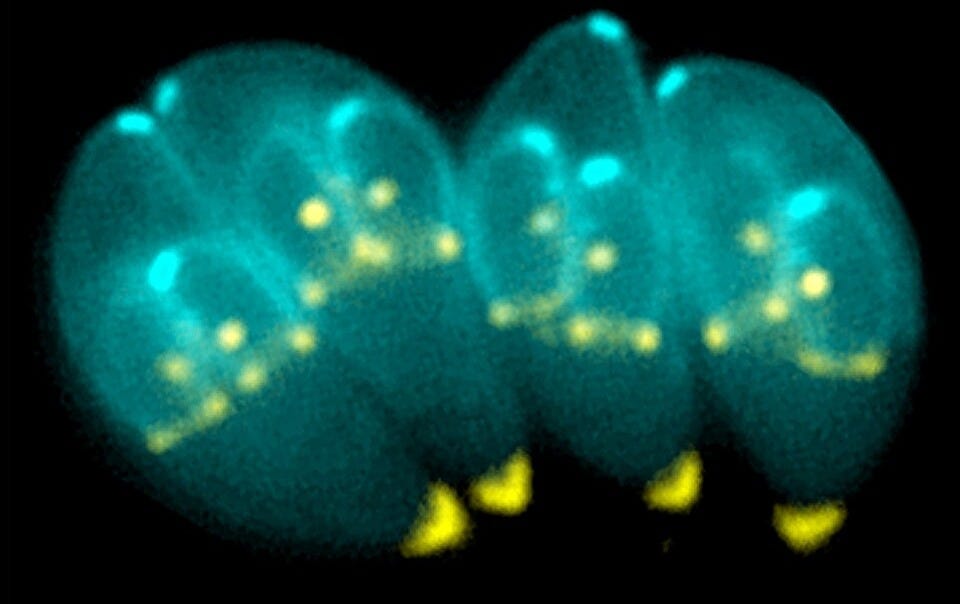
Toxoplasma gondii (Wikicommons: Ke Hu and John M. Murray)
The Encyclopedia of Sexual Psychology and Behavior has just published my entry on parasitic manipulation of human sexual behavior.
Here is the abstract:
A surprising number of tiny parasites can infiltrate brain tissue and make their current host behave in ways that help them spread to new hosts. Do such parasites exist in humans? We would be ideal vectors, given our complex neural circuitry, our social nature, and our dense populations. In fact, many microbes use our web of personal relationships, notably our sexual relationships, to go from one body to another, and natural selection should favor those that spread to the most bodies.
To increase the rate of spread, selection may act on the host’s behavior. In theory, all sexually transmitted parasites are being selected for the ability to manipulate host behavior. Because their success depends on how often and with whom their current host has sex, even a slight behavioral change may significantly help them spread to other individuals.
The full text can be found here: https://www.researchgate.net/publication/408513206_Parasites_Manipulation_of_Human_Sexual_Behavior
Comments are welcome.
Reference
Frost, P. (2026). Parasites: Manipulation of Human Sexual Behavior. In: Shackelford, T.K. (eds) Encyclopedia of Sexual Psychology and Behavior. Springer, Cham. https://doi.org/10.1007/978-3-031-08956-5_2536-1
After reading your paper, I guess that has been my (lifelong) problem wrt women and my sex life—not enough parasites. 😢
The abstract is a brilliant summary of a very complex subject! It takes so much work to do all this research and it's so difficult to summarize until after it's all been done and then finally you get an abstract that explains it perfectly😂