

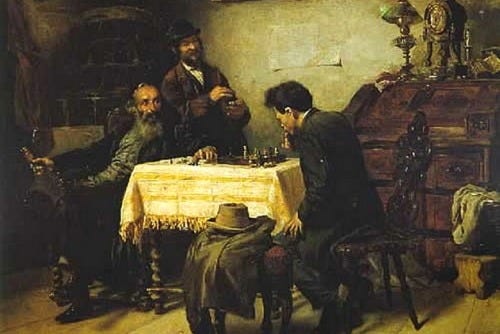
Jews playing chess, - Jehudo Epstein (1870-1945)
Four years ago, I reviewed the evidence on the cognitive ability of Ashkenazi Jews, particularly their advantage of 7 to 15 IQ points above the general European average.1 This update will concern only the genomic evidence. Noble Prizes can always be put down to culture … and Jewish moms.
The genomic evidence has grown with the emergence of two new research tools: polygenic scores and genealogical DNA testing. Both are shedding new light on cognitive evolution in different populations, including Ashkenazi Jews.
Polygenic scores (PGS)
Let’s begin with the first research tool. Polygenic scores are used to measure the genetic component of complex traits, such as height, schizophrenia, or IQ. The score itself is the predicted net effect of all the alleles (genetic variants) that are known to affect the trait positively or negatively. Many such alleles have been identified for IQ, with more remaining to be found, but we know enough of them to estimate the mean IQ of a population.
These polygenic scores are usually based on alleles associated with differences in educational attainment — a reasonable proxy for IQ. Two versions currently exist. EA3 is based on alleles at 1,271 loci identified from over one million people.2 EA4 is based on alleles at 3,952 loci identified from about three million people.3 Neither version can tell us much about the IQ of an individual, but the mean IQ of a population can be accurately estimated.4
This is because a single estimate has “noise” that we can reduce by averaging many estimates from individuals within the same population. The larger the sample of individuals, the lower the noise. In a sense, we are sampling not only the population itself but also the selection pressures acting on it, particularly those that originate in the cultural and economic environment — and which are more specific to a population than to an individual. The sample must therefore be representative; otherwise, the data may be biased.5
Polygenic scores (EA3) have been used to estimate mean Ashkenazi IQ in two studies: one with a small sample and another with a larger sample.
A study with a small sample, n=53
In a longitudinal study that ran from 1957 to 2011, Wisconsin high school students were genotyped and tested for IQ and two other measures of cognitive ability: educational attainment and a similarities test (e.g., “In what way are air and water alike”). The students came from three groups: Jews (n=53), Catholics (n=2,603), and Lutherans (n=2,027).
When a team led by Curtis Dunkel reanalyzed the data, they found that the Jewish students outperformed the Catholic and Lutheran students on all three measures of cognitive ability. They also had higher frequencies of IQ-boosting alleles.6
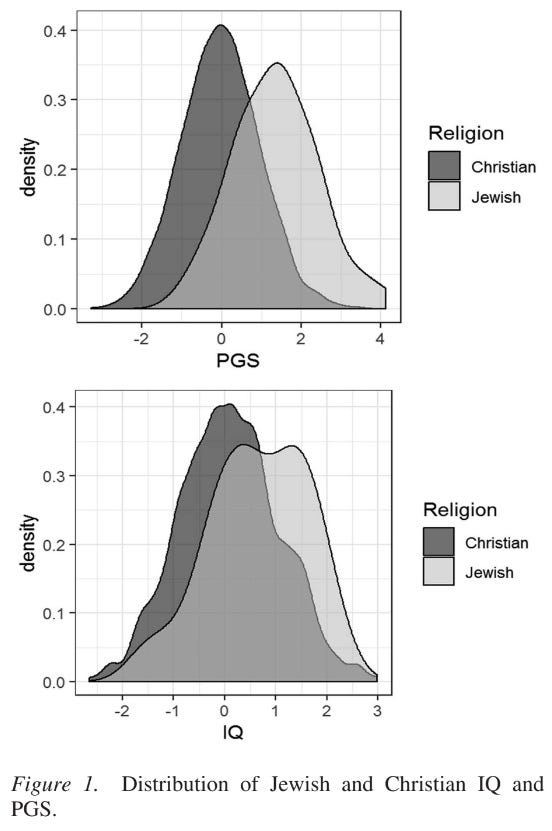
This study has been criticized for the small size of its Jewish sample and, interestingly, for its apparent tendency to overestimate Ashkenazi IQ. Whereas the polygenic scores predicted genius ability among the Jewish students, their actual IQ scores were less impressive:7
[T]he average for Jewish respondents is only about two-thirds of an SD above the mean (or about 110 in the IQ metric), and even this shrinks to just below half an SD when we look at all respondents for whom we have 1975/7 survey data in WLS, as opposed to only those for whom we have genetic data.
Polygenic scores may overestimate Ashkenazi IQ because they are disproportionately based on common alleles, which are easier to find. Rare alleles are not only harder to find but also less likely among Ashkenazi Jews, who began as a small founder group — perhaps as few as 350 individuals.8 Rare alleles may therefore contribute more to the cognitive ability of non-Jewish Europeans, who have long enjoyed a broader range of alleles within a larger gene pool.
A study with a larger sample, n=145
In a study of several populations, Davide Piffer found that Ashkenazi Jews again emerge as the highest-ranking one, with a predicted IQ of about 108. He used the Genome Aggregation Database, which not only offers a larger Jewish sample than the Wisconsin dataset but also draws on multiple sources and is thus less likely to be biased.9
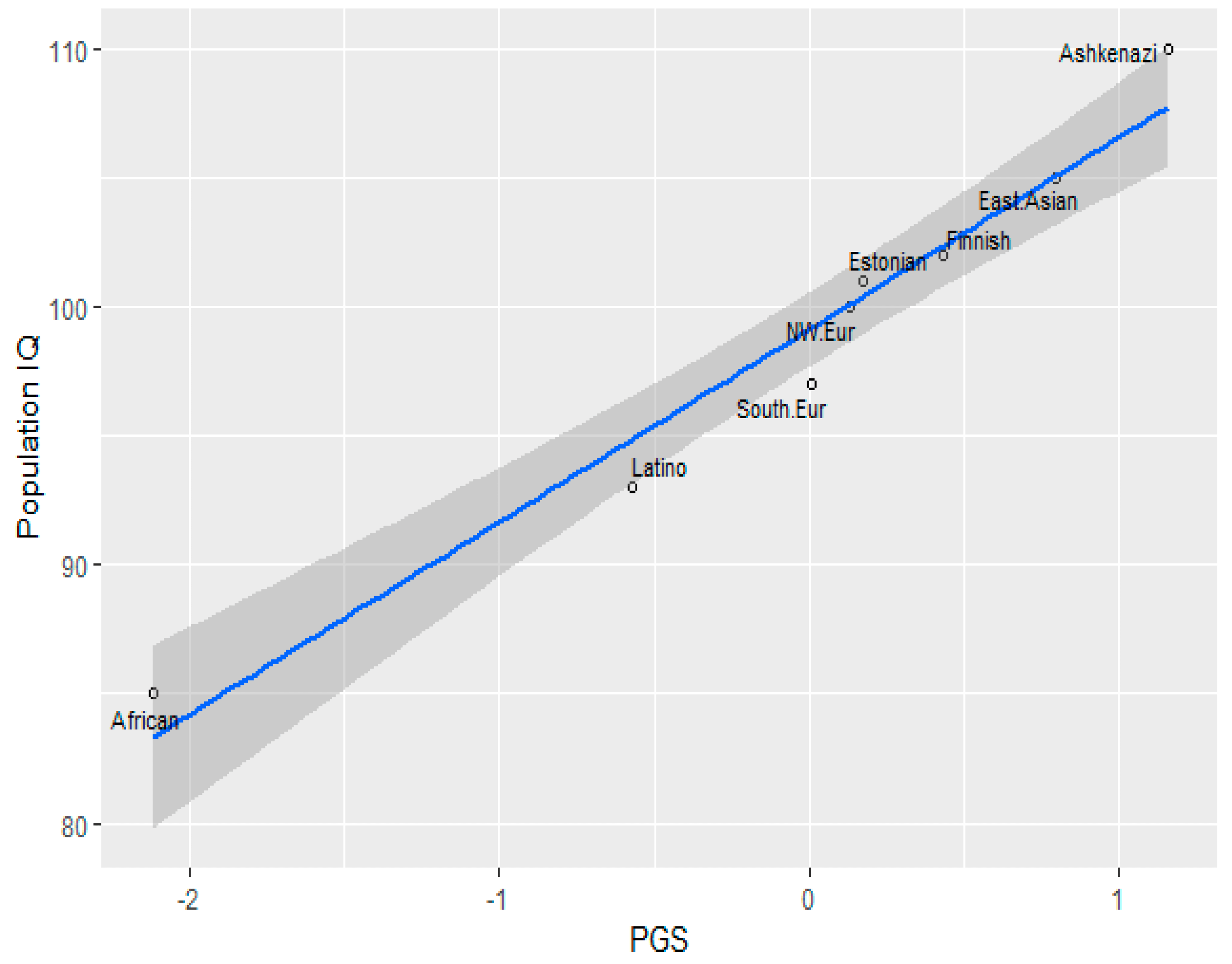
Correlation between population IQ and polygenic score (EA3) - (source)
Genealogical DNA testing
Let’s turn to the second research tool: genealogical DNA testing. It is used to verify genetic relatedness between individuals or to estimate an individual’s ethnic makeup. Recent years have seen huge improvements in accuracy, particularly with the shift from older, allele-frequency methods to newer ones that look at specific segments on the genome.
Two datasets, n=~300 and 477
Emil Kirkegaard reanalyzed data on Americans with varying degrees of Ashkenazi Jewish ancestry. The data came from two cohort studies:10
ABCD (Adolescent Brain Cognitive Development), a cohort of nearly 12,000 young Americans who have been tracked for the past 10 years
PNC (Philadelphia Neurodevelopment Cohort), a cohort of over 9,500 young people from the Philadelphia area who have been tracked for the past 15 to 17 years
In both cases, the participants were genotyped and given IQ tests. Ashkenazi ancestry was estimated using Privé’s model of ancestry and admixture.11
A high correlation, 0.85, was found between IQ and Ashkenazi ancestry. Curiously, it was much more linear in the Philadelphia cohort than in the national one. This may be because Jewish out-marriage differs between East Coast cities (like Philadelphia) and the larger U.S. population.
The average out-marrying Jewish American has a spouse with similar education and, hence, similar IQ — being typically another White American or an East Asian. The cognitive advantage is thus maintained in their half-Jewish offspring.12 But such assortative mating is less likely in Philadelphia, where marriageable high-IQ people are fewer in number — given the local demographics. Out-marrying Jews therefore pass on less of their cognitive advantage to the next generation.13
Assortative marriage by education is also less likely if the out-marrying Jewish American is less than 50% Jewish by ancestry (see charts below). Below 50%, the relationship between declining Ashkenazi ancestry and IQ becomes a simple downward diagonal. These individuals of limited Jewish heritage seem to have little, if any, affiliation with the Jewish community and are thus under less pressure to go to university and marry someone of the same IQ level. So their children regress to the population mean. This is the pattern we generally see with non-Jewish Americans, who are less prone to marry within their educational level.14
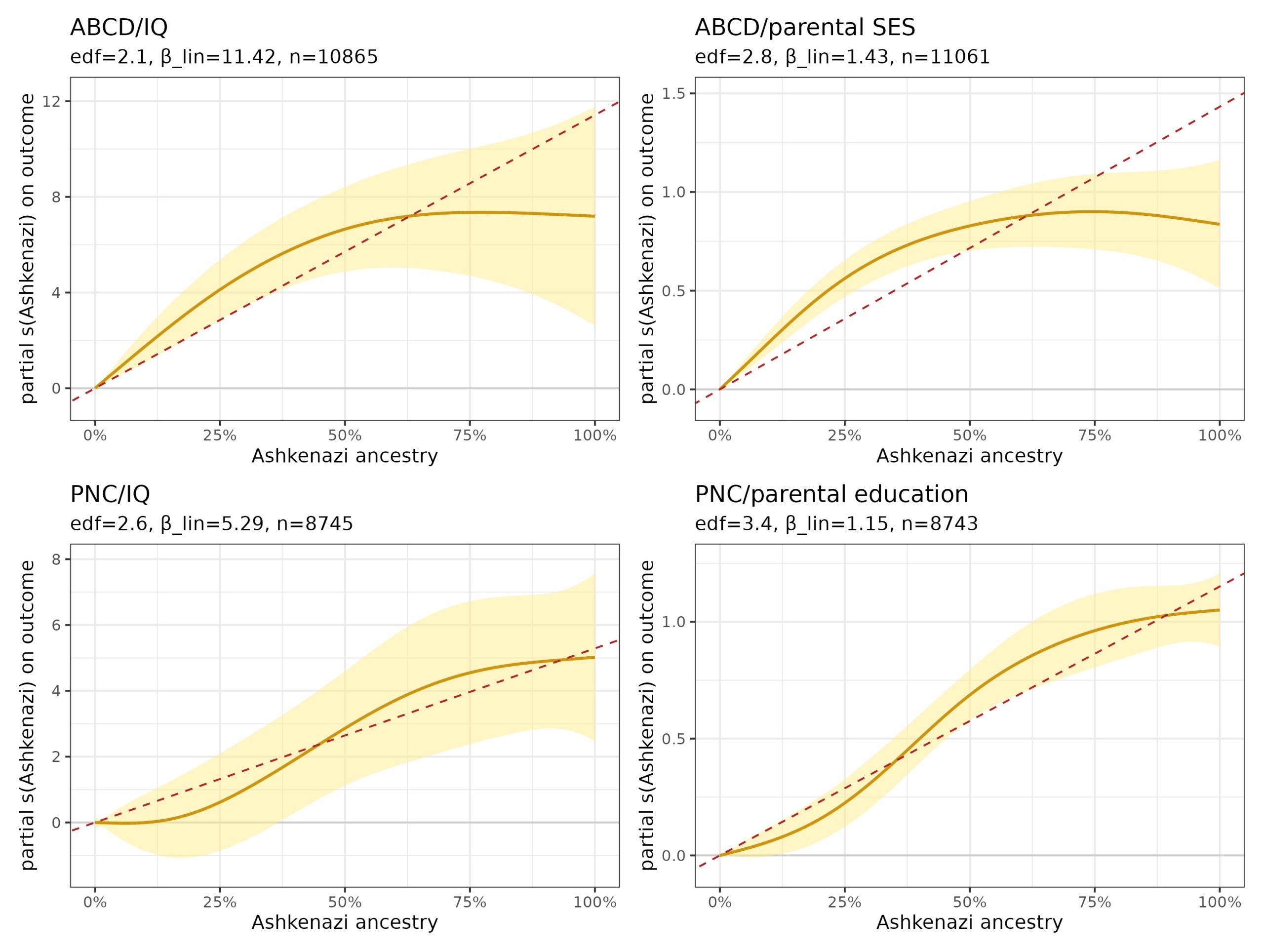
Correlations between IQ and Ashkenazi ancestry for the U.S. as a whole (ABCD cohort) and for the Philadelphia area (PNC cohort). In the righthand graphs, IQ is approximated by parental SES or parental educational attainment (Source)
Lysosome-storage disorders
This is an older area of research. As such, it provided the first hint of a genetic cause for higher cognitive ability in Ashkenazi Jews.
The Ashkenazi population has high incidences of nine neurological disorders of genetic origin: Tay-Sachs (two unrelated alleles); Gaucher’s (five unrelated alleles); Niemann-Pick; and Mucolipidosis Type IV. These disorders affect the capacity of lysosomes to store sphingolipids, which assist the growth of neuronal tissue.15 If, for instance, you have only one copy of the Tay-Sachs allele, you may benefit from faster-growing neurons and greater cognitive ability. But two copies mean early death. Selection will thus maintain the allele at an unusually high prevalence by favoring heterozygotes (i.e., people with only one copy).
Collectively, these disorders show a striking pattern. All nine arose independently in the same metabolic pathway, within the same population and, apparently, during the same last millennium or so. This doesn’t look like coincidence. This looks more like natural selection — and strong selection at that.
As Jared Diamond put it (when only eight of the disorders were known):16
In effect, lightning has struck Jewish lysosomes not once, not three times, but at least eight times. If your house is hit by lightning while a neighbour’s house goes unscathed, you may curse your bad luck, but if it happens eight times you should seek causative factors. In genetic terms, that means seeking some compensating advantage of the deleterious gene, most likely in the heterozygote …
This natural selection hypothesis has some support from one of the disorders, i.e., Gaucher’s disease:17
Professor Ari Zimran, who heads the Gaucher Clinic at the Shaare Zedek Medical Centre in Jerusalem, furnished us a list of occupations of 302 Gaucher patients. Because of the Israeli medical care system, these are essentially all the Gaucher patients in the country. Of the 255 patients who are not retired and not students, 81 are in occupations that ordinarily average IQ’s greater than 120. There are 13 academics, 23 engineers, 14 scientists, and 31 in other high IQ occupations like accountants, physicians, or lawyers. The government of Israel states that 1.35% of Israeli’s working age population are engineers or scientists, while in the Gaucher patient sample 37/255 or 15% are engineers or scientists. Since Ashkenazim make up 60% of the workforce in Israel, a conservative base rate for engineers and scientists among Ashkenazim is 2.25% assuming that all engineers and scientists are Ashkenazim. With this rate, we expect 6 in our sample and we observe.
The Shaare Zedek clinic further investigated the relationship between IQ and Gaucher’s disease by examining the normal siblings of affected patients, as stated in a letter to Brian Ferguson:
In unpublished studies by our group that asked the question whether carriers of Gaucher disease enjoy a selective advantage of increased intelligence, we administered the Wechsler Intelligence Scale and Raven Matrices to appropriately age- and sex-matched carrier and normal siblings of adults and children with Gaucher disease. Both groups had high intelligence scores.
Ferguson adds: “No scores or other details are included, and I was unable to obtain them from the clinic. But the published result is very significant […] non-carrier siblings also have high IQs. Clearly, there is something other than the Gaucher allele involved in higher intelligence or the clinic patients.”18
There is some confusion here about the terminology, particularly “normal sibling.” A normal sibling of a Gaucher patient has a two-thirds chance of being a carrier and a one-third chance of being a non-carrier. Mean IQ should therefore be higher both in carriers and in normal siblings, since most normal siblings are, in fact, carriers. Perhaps the letter writer was talking about a comparison between carrier and non-carrier normal siblings. We have no way of knowing without further information.
Natural selection or population bottleneck?
The natural selection hypothesis has been challenged by the authors of three studies:
Montgomery Slatkin examined four of the lysosome-storage disorders (LSDs) and concluded that their high prevalence among Ashkenazi Jews could be explained by founder effects after a population bottleneck between 1100 and 1400.19
A research team headed by Steven Bray examined four of the LSDs and concluded that strong selection explains the high prevalence of Tay-Sachs among Ashkenazi Jews. As for the other LSDs, the researchers were unsure: “we cannot exclude the possibility that selection of some AJ disease loci are outside the limits of detection by the extended haplotype tests, which are known to have less power to detect selection of lower frequency alleles.”20
When Neil Risch compared seven of the LSDs with seven other unusually common Ashkenazi mutations, he found no difference between the two groups in terms of geographic distribution or coalescence time.21
However, as Greg Cochran and Henry Harpending pointed out in their paper, some of these other common Ashkenazi mutations may also contribute to cognitive evolution: two affect early neurological development (Bloom syndrome and Fanconi’s anemia) and another affects the myelination of neuron sheaths (Canavan disease). In fact, one of these (Fanconi’s anemia) has been shown by Bray’s research team to be under strong selection. Furthermore, when Cochran and Harpending conducted a broader survey of 21 leading Ashkenazi mutations, they found them to be tightly clustered around a few metabolic functions. This clustering argues against the population bottleneck hypothesis, which would predict a random pattern.22
The population bottleneck hypothesis also assumes little subsequent migration into the Ashkenazi population. Otherwise, the combination of gene inflow and homozygote mortality would soon reduce the high prevalence of lysosome-storage disorders. However, a recent genomic study has estimated post-bottleneck admixture at 19-23%.23
On a final note, we should keep in mind that these disorders are merely witnesses to a broader process of genomic change. They have attracted so much research interest only because their effects are so noticeable, and serious. We should not infer that these particular mutations explain the higher mean IQ of Ashkenazi Jews. They don’t. In general, cognitive evolution has advanced through an accumulation of many new alleles of small effect, with each of them making a scarcely noticeable improvement.
Why, when and how?
Any theoretical model would have to explain why cognitive evolution went further among the Ashkenazim than among other Jews, notably the Sephardim (who lived in Spain before their expulsion in 1492 to North Africa, the Balkans, and the Middle East) and the Mizrahim (who remained in the Middle East).
Historically, the Ashkenazim diverged from other Jews in two notable ways:
Prohibition of polygyny. Ashkenazi men were forbidden to take additional wives after a synodal ruling c. 1030 in Mainz.24 Previously, a successful man could acquire second and third wives who would be progressively younger and of lower status, often former slaves.25 The desire for youth and beauty usually trumped other considerations. After the ruling, a successful man could marry only one woman (typically of high status) and have children only by her.
Cognitive evolution seems to require limits on female hypergamy, which increases reproductive success among low-status women while reducing it among high-status women — who become neglected or abandoned first wives. An increase in female hypergamy may explain why mean IQ fell during the Imperial Era of Rome, in line with the spread of polygyny among elite males and their abandonment of traditional marriage.26
A more dynamic economic environment. With the end of feudalism, and the rise of the market economy, Europe’s economic environment became more dynamic. It now rewarded those who possessed not only marketable skills but also the ability to identify market opportunities and act on them quickly.
Such individuals translated their economic success into reproductive success, as shown by the population boom among Ashkenazi Jews between the 15th and 19th centuries and their rise as a proportion of all Jews:27
At the end of the eleventh century, perhaps a century after the emergence of a division between Sephardic and Ashkenazic Jewry and their two approaches to halakhah, 97 percent of world Jewry could properly be denominated Sephardic, with only 3 percent Ashkenazic, the latter concentrated in a little area in northern France and western Germany. While the Ashkenazic population continued to grow over the following centuries, at the beginning of the modern epoch, the mid-seventeenth century, Sephardim still outnumbered Ashkenazim three to two. However, early in the eighteenth century the two groups became equal in number, and by the end of the eighteenth century Ashkenazim outnumbered Sephardim three to two, the result of improved living conditions in Christian Europe as against the Muslim world.
The timeline of cognitive evolution will be fully revealed by ancient DNA. A step in this direction has been taken with the retrieval of an allele for Gaucher’s disease from the remains of 33 Jewish individuals who lived in Erfurt, Germany, during the 14th century. They were not directly ancestral to Ashkenazi Jews; instead, both groups seem to descend from a common ancestral population in the 11th century, when Jewish merchants first settled in Erfurt.28 This date is consistent with the origin of the allele for Gaucher’s disease, which is thought to have first appeared between the 11th and 13th centuries.29
Cognitive evolution likely continued and intensified as the Ashkenazi population expanded more than a hundred-fold between the 15th and 19th centuries, an expansion mirroring that of Western Europe’s middle class and likely driven by the same cause — the shift from feudalism to a more dynamic market economy.30
The Ashkenazi cognitive advantage may therefore be relatively recent. As Steve Sailer notes, it didn’t become apparent until the Haskalah of the late 18th century, which lagged about 75 years behind the Enlightenment. Before that time, there are only isolated examples of renowned Jewish intellectuals, like Baruch Spinoza (1632-1677).31
Admittedly, the population was much smaller, with intellectual ability confined largely to Talmudic debate and commentary. What is more, like their Christian counterparts, Ashkenazi Jews were in an earlier phase of the great cognitive advance that followed the Black Death and the end of feudalism — an advance that would not reach its peak until the late 19th century.
This evolution differed in one key way between Jewish and Christian Europeans. Among the latter, it was driven by the expansion of the middle class — a substantial minority, but still a minority. In contrast, most Ashkenazi Jews were middle-class, in the sense of directly participating in the market economy as buyers and sellers.
Conclusion
The Ashkenazi cognitive advantage seems stable across the above studies. Increasing the sample size doesn’t make it go away. Nor does diversifying the sources of the sample.
Could the researchers themselves be a source of bias? This is doubtful, given their use of existing datasets that other researchers had compiled for other reasons. One cannot easily argue that certain hereditarian views biased the process of data collection.
Nor can one easily argue that the more intelligent Jews were inadvertently oversampled and the less intelligent ones undersampled. This is especially unlikely with the ABCD and PNC datasets, which were designed to be as representative of the population as possible, particularly for gender, ethnicity, and socioeconomic status.
The existing genomic evidence thus points to nature, rather than nurture, as the main factor in the remarkable intellectual performance of Ashkenazi Jews. Of course, the two factors are interdependent: parents are more willing to provide a good learning environment if their children are eager to learn.
This cognitive advantage might nonetheless be exaggerated, to some unknown extent. Current polygenic scores (EA3 and EA4) underrepresent rare alleles, which are more likely to exist in the larger gene pool of Christian Europeans. Also, current IQ tests are often biased in favor of verbal intelligence, which contributes disproportionately to Ashkenazi IQ.32
In addition to quantifying this cognitive advantage, we should determine when it began — the point in time when Ashkenazim first diverged cognitively from other populations, including other Jewish populations. Please note: I’m not arguing that the Ashkenazim started their cognitive evolution from the same mean IQ level as that of Christian Europeans. Undoubtedly, they started from a higher level, as did apparently the Sephardim and Mizrahim in relation to surrounding populations in the Middle East and North Africa.
But non-European Jews, like European Jews during feudal times, lived in a less dynamic economic environment that offered fewer opportunities for success — and, hence, for further cognitive evolution. Success depended much more on noncognitive factors, like the need for protection by powerful families. Furthermore, any rise in mean IQ was constrained by polygyny, which remained legal in Jewish communities outside Europe after being banned for Ashkenazi Jews in the 11th century.33
Cognitive differences are thus products of time and space. Because mean IQ can rise or fall within a single population over time, it may vary spatially among related populations that nonetheless share a common origin within recorded history.34 For such variability to exist, there is no need to assume extreme differences in selection between groups separated for tens of thousands of years.
Footnotes
Frost, P. (2022). Ashkenazi Jews and recent cognitive evolution. Peter Frost’s Newsletter, December 5.
Cochran, G., Hardy, J., & Harpending, H. (2006). Natural history of Ashkenazi intelligence. Journal of Biosocial Science, 38(5), 659-693. https://doi.org/10.1017/S0021932005027069
Murray, C. (2007). Jewish genius. Commentary, 123(4), 29. https://www.commentary.org/articles/charles-murray/jewish-genius/
Lee, J. J., Wedow, R., Okbay, A., Kong, E., Maghzian, O., Zacher, M., ... & Cesarini, D. (2018). Gene discovery and polygenic prediction from a genome-wide association study of educational attainment in 1.1 million individuals. Nature Genetics, 50(8), 1112-1121. https://doi.org/10.1038/s41588-018-0147-3
Okbay, A., Wu, Y., Wang, N., Jayashankar, H., Bennett, M., Nehzati, S. M., ... & Esko, T. (2022). Polygenic prediction of educational attainment within and between families from genome-wide association analyses in 3 million individuals. Nature Genetics, 54(4), 437-449. https://doi.org/10.1038/s41588-022-01016-z
Piffer, D. (2023). Signals of human polygenic adaptation: moving beyond single-gene methods and controlling for population-specific linkage disequilibrium. Qeios, July 18. https://doi.org/10.32388/hdjk5p
There is also debate as to whether a polygenic score constructed from European data can be reliably used to measure cognitive ability in non-European populations. The following studies have shown that EA3 has reliable predictive power for all human populations, particularly Eurasian populations. Differences in cognitive architecture seem to be greatest with Sub-Saharan Africans.
Fuerst, J. G., Hu, M., & Connor, G. (2024). Genetic ancestry and general cognitive ability in a sample of American youths. In: G. Connor & J. Fuerst. Studying Correlations between Genetic Variation and Test Score Gaps, (pp. 203-230). Newcastle upon Tyne: Cambridge Scholars Publishing.
Guo, G., Lin, M.J. & Harris, K.M. (2019). Socioeconomic and genomic roots of verbal ability. bioRxiv 544411. https://doi.org/10.1101/544411
Lasker, J., Pesta, B.J., Fuerst, J.G. & Kirkegaard, E.O. (2019). Global ancestry and cognitive ability. Psych, 1(1), 431-459. https://doi.org/10.3390/psych1010034
Rabinowitz, J.A., Kuo, S.I.C., Felder, W., Musci, R.J., Bettencourt, A., Benke, K., Sisto, D.Y., Smail, E., Uhl, G., Maher, B.S., Kouzis, A. & Ialongo, N.S. (2019). Associations between an educational attainment polygenic score with educational attainment in an African American sample. Genes, Brain and Behavior, 18(5), e12558. https://doi.org/10.1111/gbb.12558
Dunkel, C.S, Woodley of Menie, M.A., Pallesen, J., & Kirkegaard, E.O.W. (2019). Polygenic scores mediate the Jewish phenotypic advantage in educational attainment and cognitive ability compared with Catholics and Lutherans. Evolutionary Behavioral Sciences, 13(4), 366-375. https://psycnet.apa.org/doi/10.1037/ebs0000158
Freese, J., B. Domingue, S. Trejo, K. Sicinski, and P. Herd. (2019). Problems with a Causal Interpretation of Polygenic Score Differences between Jewish and non-Jewish Respondents in the Wisconsin Longitudinal Study. SocArXiv, 10 July https://doi.org/10.31235/osf.io/eh9tq
Carmi, S., K. Hui, E. Kochav, X. Liu, J. Xue, F. Grady, S. Guha, K. Upadhyay, D. Ben-Avraham, S. Mukherjee, et al. (2014). Sequencing an Ashkenazi reference panel supports population-targeted personal genomics and illuminates Jewish and European origins. Nature Communications 5: 4835. https://doi.org/10.1038/ncomms5835
Piffer, D. (2019). Evidence for recent polygenic selection on educational attainment and intelligence inferred from Gwas hits: A replication of previous findings using recent data. Psych, 1, 55–75. https://doi.org/10.3390/psych1010005
Kirkegaard, E. (2026). Genetic evidence of Ashkenazi intelligence, Just Emil Kirkegaard Things, April 28.
Fuerst, J. G., Hu, M., & Connor, G. (2024). Genetic ancestry and general cognitive ability in a sample of American youths. In: G. Connor & J. Fuerst. Studying Correlations between Genetic Variation and Test Score Gaps, (pp. 203-230). Newcastle upon Tyne: Cambridge Scholars Publishing.
Privé, F. (2022). Ancestry proportions and ancestry grouping, May 11. https://privefl.github.io/bigsnpr/articles/ancestry.html
Hartman, H., & Hartman, M. (2009). Gender and American Jews: Patterns in work, education, and family in contemporary life. UPNE, pp. 233-234.
Educational homogamy tends to be greater for intermarriages, especially for women and especially for those who have remarried (there is hardly any difference in educational homogamy between intramarried and intermarried men in their first marriage). As with age, there is less educational homogamy in remarriages than in first marriages, for both men and women. But intermarried couples are more likely to have the same educational attainment, for both men and women in remarriages and for women in first marriages.
American Jews tend to intermarry with spouses whose ethnic/racial backgrounds mirror the local non‑Jewish population. On the West Coast, non-Jewish spouses are often of East Asian descent.
Kim, H. K., & Leavitt, N. S. (2012). The Newest Jews? Understanding Jewish American and Asian American Marriages. Contemporary Jewry, 32(2), 135-166. https://doi.org/10.1007/s12397-012-9078-y
“In 2001-01, there was educational homogamy in 69.6% of the American Jewish couples (wives aged 18-40) compared with 55% in the broader U.S. population.” Hartman, H., & Hartman, M. (2009). Gender and American Jews: Patterns in work, education, and family in contemporary life. UPNE, p. 43.
Cochran, G., J. Hardy, & H. Harpending. (2006). Natural history of Ashkenazi intelligence. Journal of Biosocial Science, 38(5), 659-693. https://doi.org/10.1017/S0021932005027069
Diamond, J.M. (1994). Jewish Lysosomes. Nature, 368, 291-292. https://doi.org/10.1038/368291a0
Cochran, G., J. Hardy, & H. Harpending. (2006). Natural history of Ashkenazi intelligence. Journal of Biosocial Science, 38(5), 659-693. https://doi.org/10.1017/S0021932005027069
Ferguson, B. (2008). How Jews Became Smart: Anti-Natural History of Ashkenazi Intelligence. unpublished manuscript. https://www.researchgate.net/profile/R-Brian-Ferguson/publication/273369474_How_Jews_Became_Smart_Anti-Natural_History_of_Ashkenazi_Intelligence/links/54ff28410cf2741b69f414f9/How-Jews-Became-Smart-Anti-Natural-History-of-Ashkenazi-Intelligence.pdf
Slatkin, M. (2004). A population-genetic test of founder effects and implications for Ashkenazi Jewish diseases. The American Journal of Human Genetics, 75(2), 282-293. https://doi.org/10.1086/423146
Bray, S. M., Mulle, J. G., Dodd, A. F., Pulver, A. E., Wooding, S., & Warren, S. T. (2010). Signatures of founder effects, admixture, and selection in the Ashkenazi Jewish population. Proceedings of the National Academy of Sciences, 107(37), 16222-16227. https://doi.org/10.1073/pnas.1004381107
Risch, N., Tang, H., Katzenstein, H., & Ekstein, J. (2003). Geographic distribution of disease mutations in the Ashkenazi Jewish population supports genetic drift over selection. The American Journal of Human Genetics, 72(4), 812-822. https://doi.org/10.1086/373882
Cochran, G., J. Hardy, & H. Harpending. (2006). Natural history of Ashkenazi intelligence. Journal of Biosocial Science, 38(5), 659-693. https://doi.org/10.1017/S0021932005027069
Xue, J., Lencz, T., Darvasi, A., Pe’er, I., & Carmi, S. (2017). The time and place of European admixture in Ashkenazi Jewish history. PLoS Genetics, 13(4), e1006644. https://doi.org/10.1371/journal.pgen.1006644
Goldfeder, M. (2013). The story of Jewish polygamy. Columbia Journal of Gender and the Law, 26, 234. https://digitalcommons.tourolaw.edu/scholarlyworks/936/
Friedman, M. A. (1982). Polygyny in Jewish Tradition and Practice New Sources from the Cairo Geniza. Proceedings of the American Academy for Jewish Research, 49, 33-68. https://doi.org/10.2307/3622556
In the ancient Middle East, and later, women often insisted on having a marriage contract that would include both an anti-polygyny clause and an anti-slave-girl clause:
Contractual agreements to adhere to monogamy, usually in the form of a clause in the marriage contract, have a long history in polygynous societies and among Eastern Jewry. We note the oath which Laban imposed on Jacob in Gen. 31:50, not to take additional wives. The monogamy undertaking has frequently been coupled with one not to keep concubines. Monogamy and anti-slave girl clauses appeared in ancient Near Eastern contracts, as in Nuzi, in Old Assyrian documents, and in Elephantine; they also appear in Hellenistic, Greek contracts. In the Middle Ages, such a clause, not to marry a second wife or take a slave girl, is found in an eighth century Sogdian marriage document. A monogamy clause appears in Islamic marriage contracts. In some of the Arabic papyri from the late ninth century, in Egypt, the wife was assured that she would have the right to demand the divorce of a second wife. Sometimes the right to demand the sale of a slave girl was added to this.
Frost, P. (2024). How Christianity rebooted cognitive evolution. Aporia Magazine, October 10.
Elazar, D.J. (2001). Can Sephardic Judaism be reconstructed? Jerusalem Center for Jewish Affairs. https://web.archive.org/web/20061022155306/http://www.jcpa.org/dje/articles3/sephardic.htm
Waldman, S., Backenroth, D., Harney, É., Flohr, S., Neff, N. C., Buckley, G. M., ... & Reich, D. (2022). Genome-wide data from medieval German Jews show that the Ashkenazi founder event pre-dated the 14th century. Cell, 185(25), 4703-4716. https://doi.org/10.1016/j.cell.2022.11.002
Wikipedia. (2026). Erfurt. https://en.wikipedia.org/wiki/Erfurt
Colombo, R. (2000). Age estimate of the N370S mutation causing Gaucher disease in Ashkenazi Jews and European populations: A reappraisal of haplotype data. American Journal of Human Genetics, 66(2), 692-697. https://doi.org/10.1086/302757
Behar, D. M., Hammer, M. F., Garrigan, D., Villems, R., Bonne-Tamir, B., Richards, M., ... & Skorecki, K. (2004). MtDNA evidence for a genetic bottleneck in the early history of the Ashkenazi Jewish population. European Journal of Human Genetics, 12(5), 355-364. https://doi.org/10.1038/sj.ejhg.5201156
Frost, P. (2026). Cognitive evolution in Western Europe. Peter Frost’s Newsletter, February 16. https://www.anthro1.net/p/cognitive-evolution-in-western-europe
Sailer, S. (2019). NYT: “The Secrets of Jewish Genius.” The Unz Review, December 28. https://www.unz.com/isteve/nyt-the-secrets-of-jewish-genius/
Genç, E., Schlüter, C., Fraenz, C., Arning, L., Metzen, D., Nguyen, H. P., ... & Ocklenburg, S. (2021). Polygenic scores for cognitive abilities and their association with different aspects of general intelligence—a deep phenotyping approach. Molecular Neurobiology, 58(8), 4145-4156. https://doi.org/10.1007/s12035-021-02398-7
Lynn, R. (2004). The intelligence of American Jews. Personality and Individual Differences, 36(1), 201-206. https://doi.org/10.1016/S0191-8869(03)00079-5
StatJew (2026). Just how dumb are Mizrahim? June 28.
Goldfeder, M. (2013). The story of Jewish polygamy. Columbia Journal of Gender and the Law, 26, 234. https://digitalcommons.tourolaw.edu/scholarlyworks/936/
Akbari, A., Perry, A., Barton, A.R. et al. (2026). Ancient DNA reveals pervasive directional selection across West Eurasia. Nature April 15. https://doi.org/10.1038/s41586-026-10358-1
Frost, P. (2012). Tay-Sachs and French Canadians: A case of gene-culture co-evolution? Advances in Anthropology 2(3): 132-138. http://dx.doi.org/10.4236/aa.2012.23016
Frost, P. (2026). Cognitive evolution in Western Europe. Aporia Magazine, January 15.
Piffer, D., & Kirkegaard, E. O. (2024). Evolutionary trends of polygenic scores in European populations from the Paleolithic to modern times. Twin Research and Human Genetics, 27(1), 30-49. https://doi.org/10.1017/thg.2024.8
Oh, yeah! I've been thinking about this since our interview in late April. Over the past five years, I've read articles by different people about Jewish IQ. But when you brought up Tay-Sachs, you explained how it relates to Jewish intelligence. I knew Jews could have Tay-Sachs, but I didn't realize it was thought to have a positive influence on intelligence.
"In contrast, most Ashkenazi Jews were middle-class, in the sense of directly participating in the market economy as buyers and sellers."
Are you sure about that? After reading Singer and other Jewish writers' descriptions, I got the idea that there quite a few proletarian Jews in. the shtetls, with the very poorest sometime leaving the Jewish communities altogether. On the other hand, the richest and most successful families had more children. Wouldn't Gregory Clark's argument come into play here?